

Standardizing Reagent Preparation: Ready-to-Use Solutions in Life Science Workflows
For pharmaceutical and biotechnology organizations, reproducibility is not simply a desirable characteristic of laboratory work—it is an operational requirement. From early-stage research and analytical testing through process development and manufacturing, the reliability of a workflow depends on controlling the variables that can influence its outcome.
Reagents are one of those variables.
Many laboratory workflows depend on aqueous solutions, buffers, salts, and other reagents that are prepared internally before use. While in-house preparation can provide flexibility, every additional preparation step introduces an opportunity for variability. Differences in weighing, dilution, mixing, water quality, handling technique, storage, and environmental exposure can all influence the final solution.
Ready-to-use (RTU) reagents provide an alternative approach. Rather than requiring laboratory personnel to formulate or dilute a solution before use, RTU products are manufactured, tested, packaged, and supplied at a defined specification for their intended application. This shifts reagent preparation from an individual laboratory task to a controlled manufacturing process.
For organizations working to improve reproducibility, efficiency, and scalability, that distinction can have significant operational value.
Reagent Preparation as a Source of Laboratory Variability
Reducing Operator-Dependent Variability
The preparation of a reagent may appear straightforward: measure the appropriate components, combine them with a specified solvent, adjust the formulation as necessary, and confirm the final concentration or pH. In practice, however, each step can introduce variation.
Measurement equipment must be properly calibrated. Raw materials must meet the required specifications. Mixing must be sufficiently uniform. Dilutions must be calculated and executed correctly. Personnel must follow the same procedures from one preparation to the next.
These variables become increasingly important when workflows are performed by multiple operators, across multiple shifts, or at different facilities.
RTU reagents remove many of these preparation-dependent variables from the laboratory workflow. A solution manufactured to an established formulation can provide a more consistent starting material than repeated preparation at the point of use. This does not eliminate every source of experimental variability, but it can reduce the number of variables that laboratory personnel must control.
For example, Lifecycle Biotechnologies offers ready-to-use solutions through its Simple Lifecycle portfolio, including DNase/RNase-free sterile water, saline, buffered solutions, and other commonly used laboratory reagents. These products are manufactured to defined specifications and supplied in formats intended for direct use.
Controlling Purity and Contamination Risk
Reagent quality extends beyond concentration. Depending on the application, laboratories may need to control factors such as microbial contamination, endotoxins, nucleases, proteases, particulates, and other impurities.
Manual preparation increases the number of handling and exposure points between the source materials and the final reagent. Every transfer, container opening, measurement, or dispensing step represents another opportunity for contamination or unintended variation.
A manufactured RTU reagent allows more of that control to occur before the product reaches the laboratory. Rather than relying entirely on point-of-use preparation, organizations can establish requirements for the reagent itself—including formulation, purity, sterility, packaging, and applicable testing specifications—and source the material accordingly.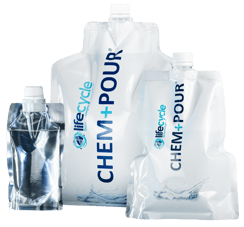
Packaging is also part of this equation. Lifecycle’s CHEM+POUR™ system, for example, is designed to support controlled pouring while reducing splashing and glugging associated with conventional bottles. The system is available for applications including USP purified water, sodium chloride, hydrochloric acid, and other solutions.
The objective is not simply to make a reagent easier to use. It is to consider the entire path from manufacturing through final application and identify where variability and unnecessary handling can be reduced.
Standardization Without Sacrificing Workflow Flexibility
From Preparation to Immediate Use
One of the most direct advantages of an RTU reagent is the elimination of preparation steps immediately before an experiment or process.
Removing dilution, mixing, and formulation from the laboratory workflow can reduce preparation time and allow personnel to move directly into testing, experimentation, or production activities. In high-throughput environments, even relatively short preparation tasks can accumulate into substantial labor requirements over time.
The greater value, however, comes from standardization. When the same reagent is supplied according to a defined formulation and specification, laboratories can establish a more consistent input across repeated workflows.
This can be particularly valuable when an organization is attempting to reproduce a method across multiple teams or facilities. Standardized inputs can simplify method transfer by reducing differences introduced through local reagent preparation.
Application-Specific Reagent Design
Standardization does not mean that every application requires the same reagent.
Molecular biology, cell-based workflows, diagnostics, analytical testing, and pharmaceutical manufacturing can have very different requirements for purity, sterility, composition, and packaging. Selecting a reagent based on the requirements of the application is therefore an important part of controlling process variability.
Lifecycle’s portfolio includes application-specific solutions such as molecular biology-grade water designed to be DNase- and RNase-free, as well as USP-grade solutions intended for pharmaceutical and microbiological applications.
This approach allows organizations to standardize where appropriate without forcing a single reagent specification across fundamentally different processes.

Consistency Across Scale and Location
Reagent standardization becomes even more relevant as organizations grow.
A formulation prepared by one scientist in an R&D laboratory may not be prepared identically by another scientist, another shift, or another facility. Differences can become more pronounced when a process moves from development into validation or manufacturing.
Using a manufactured reagent with established specifications can help organizations maintain greater consistency as workflows scale. Lifecycle’s manufacturing capabilities include multiple mixing capacities and aseptic package sizes ranging from small laboratory formats to larger production volumes, supporting applications across different stages of the life science workflow.
This type of scalability can be particularly useful when organizations are attempting to maintain continuity between laboratory development and larger-scale operations.
The Operational Value of Ready-to-Use Reagents
Improving Laboratory Efficiency
The most visible benefit of RTU reagents is time.
Laboratory personnel spend significant amounts of time preparing materials that are necessary for experiments but are not themselves the primary scientific objective. Eliminating repetitive preparation activities can allow those resources to be redirected toward experimentation, analysis, process development, and other higher-value activities.
For organizations evaluating RTU reagents, the relevant question is therefore not simply the purchase price of the reagent. The broader calculation can include preparation labor, raw-material procurement, equipment requirements, quality checks, storage, waste, documentation, and the potential cost of troubleshooting variability.
A manufactured solution can consolidate many of these activities into a controlled supply process.
Supporting Quality and Compliance
For pharmaceutical and biotechnology organizations, reagent selection also intersects with quality systems.
A laboratory-prepared reagent may require documented preparation procedures, raw-material controls, calculations, equipment checks, operator training, labeling, storage requirements, and appropriate quality verification. Depending on the application and regulatory environment, these controls can become increasingly complex.
Sourcing a reagent from a manufacturer does not automatically make a downstream process compliant, nor does it eliminate an organization’s responsibility to qualify materials for its intended use. It can, however, provide an additional layer of control by moving reagent formulation and manufacturing into an established quality system.
Lifecycle Biotechnologies maintains ISO 9001 and ISO 13485 certifications and operates FDA-registered manufacturing facilities, with documented quality systems intended to support biotechnology, pharmaceutical, and medical device applications.
For organizations evaluating an RTU reagent supplier, factors such as manufacturing controls, testing requirements, traceability, documentation, packaging, and supplier qualification should therefore be considered alongside the technical specifications of the reagent itself.
Simplifying Procurement and Inventory
RTU reagents can also change how laboratories approach procurement.
Instead of maintaining inventories of multiple raw materials needed to prepare a solution, organizations can source a finished reagent according to a defined specification. This can simplify material management and reduce the number of components that must be individually purchased, stored, monitored, and replenished.
The effect can be particularly relevant for commonly used solutions where laboratory personnel repeatedly perform the same preparation.
Lifecycle’s off-the-shelf reagent offerings are designed around this concept, providing commonly used solutions in ready-to-use formats with products available for immediate shipment.
For organizations with specialized formulations, the same principle can extend beyond standard catalog products. Lifecycle also supports custom formulation and technology transfer, translating customer-specific or semi-custom formulations into manufactured products with defined packaging and testing requirements.
Moving Reagent Control Upstream
The strategic value of ready-to-use reagents ultimately comes down to control.
Every laboratory workflow contains variables. Some are intrinsic to the science and cannot be eliminated. Others are introduced by how materials are prepared, handled, packaged, and delivered.
RTU reagents provide an opportunity to move control of certain variables upstream—from individual laboratory preparation into a standardized manufacturing environment.
For pharmaceutical and biotechnology companies, that can support several objectives simultaneously: reducing preparation-dependent variability, improving workflow efficiency, simplifying material management, and establishing greater consistency across operators, laboratories, and facilities.
The right RTU reagent is therefore more than a convenient alternative to in-house preparation. It is a component of the broader process-control strategy.
Lifecycle Biotechnologies manufactures ready-to-use reagents, processing fluids, and custom chemistries designed to support applications across the life science industry. From standardized laboratory reagents to application-specific and custom formulations, Lifecycle works with customers to define product specifications, manufacturing processes, packaging configurations, and testing requirements around the needs of the application.
As life science organizations continue to prioritize reproducibility, efficiency, scalability, and control, the question is increasingly not whether a reagent can be prepared internally, but whether it needs to be. In workflows where preparation introduces unnecessary variability or consumes valuable resources, a properly specified ready-to-use reagent may provide a more controlled and efficient path from material selection to reliable laboratory performance.
Explore Lifecycle Biotechnologies’ ready-to-use reagent solutions or contact our team to discuss reagent specifications, application requirements, and custom manufacturing options.


