
Testing Water for Pharmaceutical Applications
Manufacturing pharmaceuticals, medical devices, biologics, cell- and tissue-based products, and numerous other medical products demands substantial amounts of water. The United States Pharmacopeia (USP) <1231> categorizes and describes the different types of water available. These water types are determined through various testing methods. The following definitions can help navigate these complexities by providing a better understanding of the analytical and microbiology testing requirements outlined in USP <1231>.
Total Organic Carbon (TOC) testing serves as a screening method to identify organic molecules introduced from various sources, including source water, purification and distribution system materials, and biofilm growth within the system.
Conductivity testing measures the ion-facilitated electron flow through water. Water molecules dissociate into ions based on pH and temperature, resulting in a highly predictable conductivity. Factors like CO₂ and dissolved inorganic solids (e.g., chloride, nitrate, sulfate, phosphate anions, sodium, magnesium, calcium, iron, aluminum cations) can affect conductivity.
Bacterial Endotoxins Testing (BET), also known as pyrogen testing, employs Limulus Amebocyte Lysate, a reagent extracted from the blood of the horseshoe crab (Limulus polyphemus), to detect the presence of bacterial endotoxin in water. Bacterial endotoxin, found in the cell wall of gram-negative bacteria, triggers fever in mammals.
Sterility testing involves examining water to ascertain the presence or absence of viable microorganisms on products or parts of them.
Microbial Enumeration testing quantifies mesophilic bacteria and fungi that thrive in aerobic conditions. These tests primarily assess whether water meets established microbiological quality standards.
Particulate testing is particularly crucial in injections and parenteral infusions that contain extraneous, mobile, and undissolved particles, excluding gas bubbles, unintentionally present in the solutions. Water designated for use in injectable products must undergo this testing to ensure that the source water does not introduce particulate matter into the final product, which could be administered intravenously.
Antimicrobial Agents testing demonstrates the effectiveness of antimicrobial protection. Antimicrobial preservatives, toxic substances added to non-sterile dosage forms, protect them from microbiological growth or from microorganisms inadvertently introduced during or after manufacturing. In the case of sterile articles packaged in multiple-dose containers, antimicrobial preservatives are added to inhibit the growth of microorganisms that may be introduced from repeatedly withdrawing individual doses.
pH testing measures the negative logarithm of the hydrogen ion activity in water.
Calcium, Carbon Dioxide, and Sulfates are all qualitative tests used to determine the quantities of these minerals present in water.
Understanding Water Test Types and Regulatory Requirements
Having a comprehensive understanding of each test type will serve as a roadmap for how water affects each product. Using a less stringent water type for a product based on its intended use could be a costly mistake. Conversely, using a more stringent water type when not required could lead to increased costs. Considering the increasing scrutiny of the ever-evolving regulatory landscape, it becomes even more crucial to have a thorough understanding of the water a process requires.
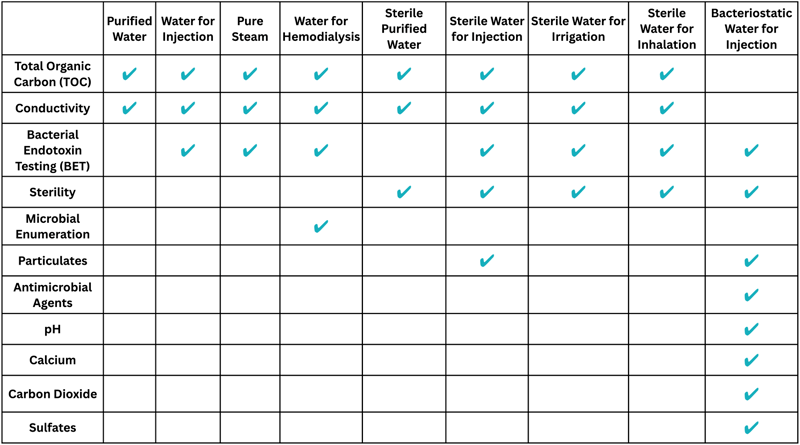
The final piece is knowing which tests are required for each type of water. Table 1 summarizes the requirements to claim a particular water type.
Water, as evident, is far more intricate than it appears. As a crucial resource for manufacturing, processing, and patient care, it is imperative that you invest time in comprehending the quality of the water being utilized and its potential impact on your products and processes.


